


The Iraqi Economy… A Journey of Recovery in a Time of Challenges
The Iraqi economy is navigating a complex journey of recovery, battling deep-rooted challenges like corruption, severe oil dependency, and banking defects to achieve sustainable diversification

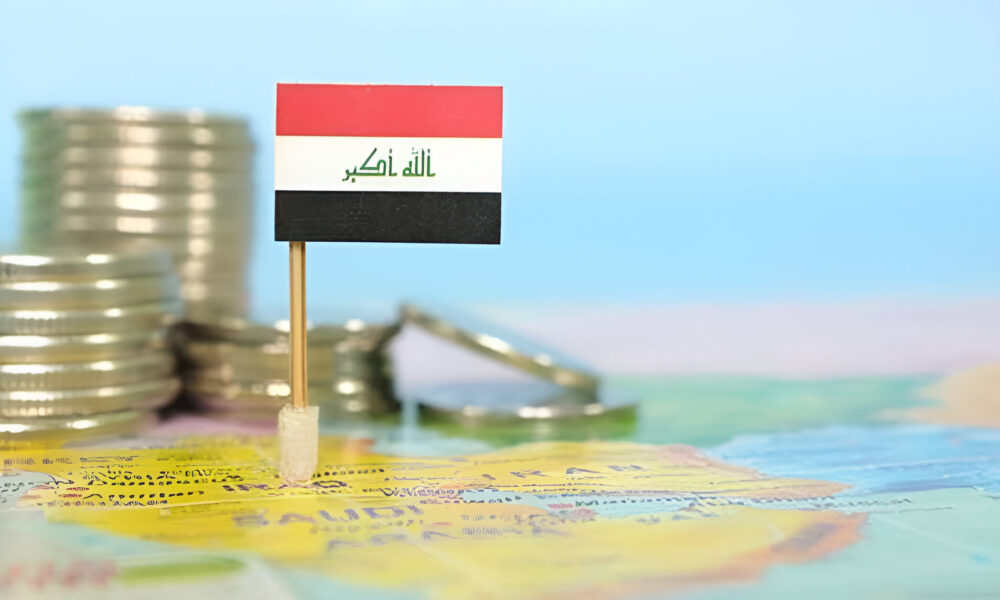
The meeting between the American Civil Administrator of the Coalition Provisional Authority in Iraq, Paul Bremer, and a group of Iraqi financial and economic experts in the summer of 2003 was stormy and tense. This was due to the Iraqi expert team’s rejection of American proposals that would allow the Coalition Authority to control Iraqi oil funds and take direct responsibility for settling the financial requirements of Iraqi state institutions without consulting official Iraqi parties. The pretext given was that the country was under American authority and that there were no Iraqi institutions or cadres ready to manage the oil wealth.
Table Of Content
- How the Iraqi economy collapsed?
- High Rentierism
- Petrodollar Funds
- The Defect in the Banking System
- What Are the Main Economic Sectors in Iraq?
- The Oil and Gas Sector
- The Industrial and Developmental Sector
- The Agricultural Sector
- The Transport Sector and Its Projects
- The Development Road Project
- The Baghdad Metro Project
- How Can the Iraqi Economy Be Fortified?
After a tug-of-war between the two sides, it was agreed that the Central Bank of Iraq would establish an auction to sell US dollars to the Iraqi commercial and industrial sectors in order to sustain economic activity and feed the state’s finances. This marked the beginning that forever changed the face of the Iraqi economy.
Despite more than two decades having passed since the regime change in Iraq, the shape of the Iraqi economy has not yet settled into a clear, independent identity. The dominant features of this economy still blend the socialism of the past with the capitalism of the present in an unusual mix that could persist for decades to come. This is due to numerous financial, political, security, administrative, and legislative obstacles and challenges that have severely delayed the process of reforming the national economy and reviving it.
How the Iraqi economy collapsed?
Over the decades, Iraq has experienced an economic journey fraught with challenges and fluctuations. This began in the 1980s, which tested the country’s resilience during a grueling war with Iran that drained its coffers and cast a heavy shadow over economic performance. This was followed by the Gulf War (Liberation of Kuwait), which resulted in devastating losses estimated in the hundreds of billions, and subsequently led to sanctions and external control over Iraqi oil resources.
These harsh conditions deeply impacted the structure of the Iraqi economy, leaving behind massive challenges and problems that persist today and hinder efforts for growth and development. Given this reality, the question arises as to how Iraq can confront these monumental challenges and embark on a new phase of economic reform and development.
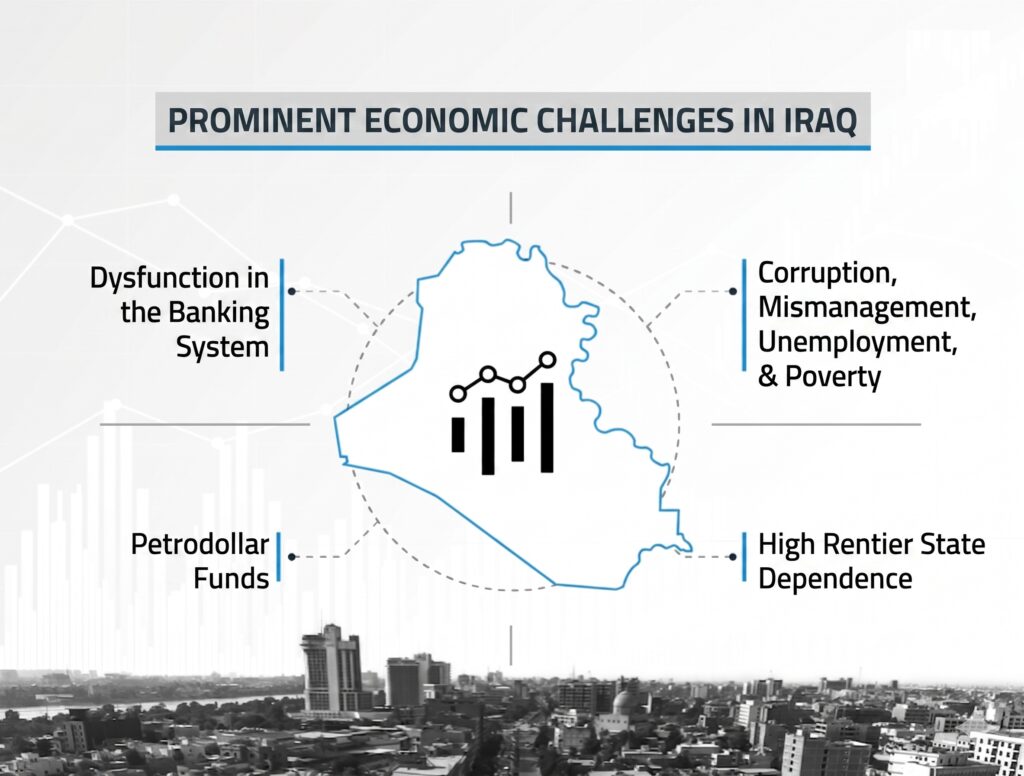
Corruption, Mismanagement, Unemployment, and Poverty.
Financial and administrative corruption acts like a tumor that has spread through the body of the economy, eating away at the state’s foundations. Funds looted over the past two decades are estimated at hundreds of billions of dollars, placing Iraq high on global corruption indices.
The profound impact of corruption on the economic environment is evident in the depletion of the state treasury and the deterioration of vital sectors. Productive and service industries suffer, infrastructure is in a dismal state, and state institutions are heavily infiltrated by organized corruption networks.
Furthermore, the social repercussions of this rampant corruption are just as dangerous as its economic impacts, as there is no equity in the distribution of wealth or job opportunities. Unemployment rates climbed to 16.5% at the beginning of 2024, and poverty rates surged to approximately 22% according to the Iraqi Ministry of Planning (meaning roughly 10 million Iraqis live in poverty).
It is also impossible to ignore the presence of 6 million orphans and 2 million widows the legacy of previous wars and conflicts in addition to more than 4 million people living in slums and marginalized neighborhoods.
High Rentierism
Two decades after the US invasion, the Iraqi economy continues to struggle to break free from its severe dependence on oil, often referred to as a petroleum “rentier economy”. Oil revenues make up over 95% of the Gross Domestic Product (GDP). This over-reliance makes Iraq highly vulnerable to global oil price fluctuations, as its financial stability is inextricably linked to the volume of oil exports, resulting in a fragile economy highly exposed to external shocks.This dependence causes the Iraqi economy to swing wildly between financial abundance and crippling deficits.
For example, in 2020, the GDP shrank by 11% due to the collapse in oil prices, whereas in 2022, the economy saw a positive growth rate of 9.3% fueled by rising oil prices.
This intense rentierism and the economy’s linkage to the price of a barrel of oil severely obstruct medium- and long-term economic planning and prevent the establishment of a sustainable economic environment.
Petrodollar Funds
At the core of Iraqi monetary and fiscal policy lies a complex financial and legal situation where politics intertwines with economic sovereignty. Under post-2003 agreements, Iraqi oil revenues do not flow directly into the state treasury. Instead, they are transferred to the US Federal Reserve and deposited into a special account initially named the “Development Fund for Iraq,” which later became known as “Iraq-2”.
The stated objective behind this procedure is to provide American protection for Iraqi assets from international claims and compensation lawsuits, in accordance with US Presidential Executive Order 13303. It allows Iraq to withdraw the amounts of dollars it needs, direct them toward investments in US Treasury bonds, gold, and other assets, and channel a portion of these funds into the currency auction managed by the Central Bank of Iraq. This auction serves as the primary mechanism for financing commercial operations, fueling the government’s payment and financial systems, and maintaining the stability of the Iraqi dinar against the US dollar.
However, this setup raises concerns among many Iraqi observers and experts who view it as a limitation on national sovereignty and an interference in Iraq’s financial and monetary affairs. They consider this a curtailment of Iraq’s right to fully control its resources in the same manner as other sovereign nations.
Recently, Iraqi and US monetary authorities agreed to phase out the auction (or “window”) operations and transition gradually toward direct international wire transfers. This shift could mark the beginning of Iraq reclaiming its sovereign right to independently receive and manage its oil revenues, free from the dominance of the US Federal Reserve.
The Defect in the Banking System
The Iraqi banking system has faced numerous twists and turns during the years of its post-2003 restructuring. It saw broad regulatory easing that led to the opening of dozens of private banks, bringing the total number to 74. This includes 7 government banks, 16 non-Iraqi banks from Turkey, Iran, Lebanon, and Jordan, and a mix of local commercial and Islamic banks.
Some reports indicate that many of these banks were established with a single primary goal: to profit from US dollar sales via the auction or dollar window launched by the Central Bank of Iraq, whether through exchange rate margins or external transfers.
This heavy focus on auction operations led to limited credit offerings and a lack of other standard banking services that should be provided to individuals and businesses. This contributed to a reluctance among many segments of society to use banks, further entrenching a lack of trust in the Iraqi banking system and exacerbating the phenomenon of individuals hoarding cash at home rather than saving and investing it in banks.
The clear reliance of Iraqi banks on limited auction-related transactions, coupled with weak public trust and shortcomings in the Central Bank’s regulatory and developmental oversight, significantly contributed to the ongoing poor quality of Iraqi banks, both in their internal structures and their adherence to required domestic and international banking standards. This environment resulted in a notable percentage of banks being implicated in suspected money laundering operations, dollar smuggling, and providing support to entities and countries under US economic sanctions.
This compelled the US Treasury, acting through the Federal Reserve, to penalize certain Iraqi banks, barring them from accessing dollars through the window. They also increased restrictions and controls over the entire electronic system, coordinating with the Central Bank of Iraq to launch an electronic platform in late 2022 and activating the regulations of the global “SWIFT” system for international transfers.
These strict US measures and the penalization of dozens of Iraqi banks reduced the supply of dollars within the Iraqi economy while demand remained high, leading to unprecedented spikes in dollar exchange rates.
Nevertheless, the Central Bank of Iraq and the government attempted to manage this crisis through several measures. The most significant steps included raising the official value of the Iraqi dinar against the dollar, cracking down on cross-border dollar smuggling and speculation in unofficial parallel markets, and designating official channels for the sale and delivery of dollars.
Roughly 18 months into the Iraqi banking system’s crisis and its clash with the US Federal Reserve, the economy remains under the shadow of this turmoil. This is evident in the lingering discrepancies between official dollar exchange rates and parallel market rates, as well as the fact that nearly 30% of Iraqi banks remain under federal sanctions.
This persists despite an overall improvement in banking performance and a compliance rate with US regulations that has surpassed 80%, according to the Iraqi Prime Minister. There has also been a gradual shift away from selling dollars via the electronic platform, moving instead toward direct external transfers executed by Iraqi banks through international correspondent banks that streamline the transfer process.
Iraqi monetary and fiscal authorities are continuing their efforts to contain and resolve this monetary crisis. There is a lingering fear that if it continues, it could constrain the flow of dinars needed to fund public finances and meet the requirements of the triennial budget.
What Are the Main Economic Sectors in Iraq?
The Oil and Gas Sector
The Iraqi oil sector is a giant characterized by its cohesion and expansion, with oil and gas acting as the country’s lifeline and contributing over 95% of the GDP.
Since 2003, Iraq has experienced a clear oil renaissance, managing to significantly boost its production levels. This was facilitated by opening up to specialized international energy companies through a new contracting framework known as “licensing rounds”. Consequently, production surged from 3 million barrels per day (bpd) in 2003 to more than 4.22 million bpd by the final quarter of 2023.
The growth did not stop there; oil exports leaped to 3.4 million bpd in the first quarter of 2024, generating monthly financial revenues ranging between $8 billion and $11 billion. Despite possessing expansion plans aiming to reach 5 million bpd by 2025, Iraq faces challenges posed by “OPEC Plus” agreements, which may curb its ambitions to increase export volumes.
As for the Iraqi gas production sector, it serves as another essential pillar on the path toward achieving future independence from foreign gas sources. The Iraqi government aims to reach gas self-sufficiency by the end of this decade, gradually eliminating the need for external gas imports, particularly those from Iran. Reliance on Iranian gas has caused multiple problems for Iraq, ranging from supply interruptions to difficulties in paying gas bills due to US sanctions on Iran.
To achieve this strategic goal, the Iraqi Ministry of Oil, partnering with global corporations like TotalEnergies and Gazprom, has begun developing gas production across several fields, including “Artawi,” “Mansuriya” in Diyala, and “Akkas” in western Iraq. Additionally, focus is being placed on channeling resources to capture associated gas that is currently flared and wasted during oil extraction.
The Industrial and Developmental Sector
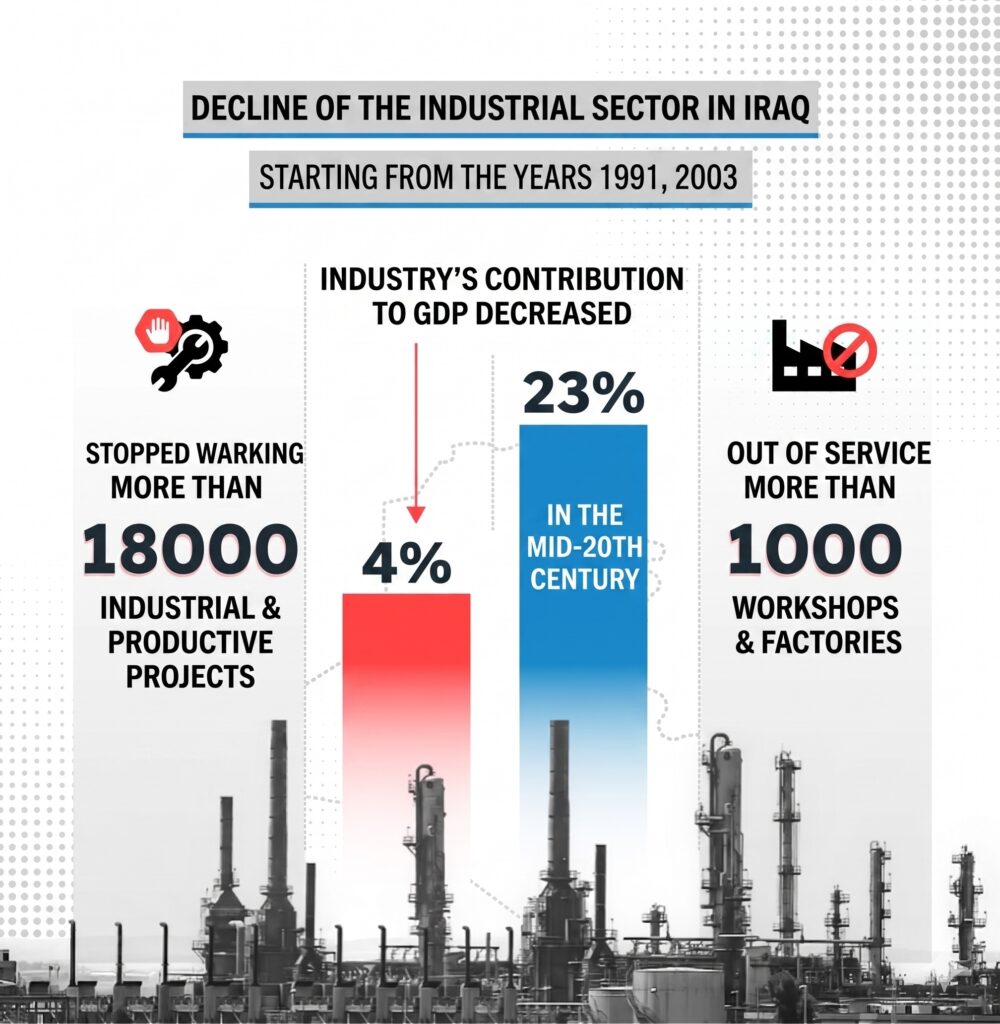
In the mid-20th century, Iraq emerged as one of the preeminent industrial nations in the Middle East. During the 1950s, Baghdad launched a staggering developmental campaign that established a massive and diversified industrial ecosystem. This encompassed pharmaceuticals, textiles, fertilizer production, food processing, and extended to heavy industries such as iron and steel, refining, and petrochemicals.
This industrial boom accounted for 23% of Iraq’s GDP. However, through successive political regimes and relentless internal and external conflicts, this industrial might began a dramatic decline. The sector suffered devastating blows between 1991 and 2003, leading to the destruction and closure of many national factories, a collapse in production, and a drop in the industrial sector’s GDP contribution to below 4%. Over 1,000 factories and plants were rendered out of service, and more than 18,000 industrial and productive projects were halted.
During those years, the industrial sector morphed from an economic pillar into a burden that pressured the state’s public finances. This was due to the hefty operational costs the government paid to maintain non-producing state-owned factories, indirectly reinforcing an import-heavy economy and increasing reliance on foreign goods.
This legacy presented a massive challenge to successive post-2003 governments, whose efforts were marked by sluggishness and a failure to adopt or implement suitable plans to revive the industrial sector and pivot toward industrial development and economic diversification.
In recent years, relevant Iraqi ministries have proactively drafted plans aimed at investing in industrial development, rehabilitating defunct factories, and creating new industrial centers to support national economic diversification. Despite these efforts, substantial hurdles remain that stall developmental and reform programs. Corruption eats away at state institutions, while political, security, legislative, and bureaucratic challenges consistently throw a wrench in the gears of progress.
The Agricultural Sector
For half a century, agriculture was a crucial tributary to the Iraqi economy. This sector evolved through various stages over the decades, seeing land reclamation, the modernization of irrigation systems, and increased crop yields. Iraqi agriculture ultimately became a lifeline for the populace during the punishing years of economic sanctions between 1991 and 2003.
Like other sectors, it has faced massive challenges, from the fallout of wars and conflicts to climate change, water scarcity, and mismanagement. This resulted in a decline in agricultural abundance, a reduction in arable land, and the migration of farmers from rural villages to cities.
In response, the Iraqi government took steps to improve the sector. These efforts bore fruit in 2024 when wheat production climbed to 2 million tons, achieving the goal of national self-sufficiency. The success was not limited to wheat; date production also saw a notable surge, securing Iraq the rank of the fourth-largest date exporter globally.
Despite this headway, the path forward for Iraqi agriculture remains fraught with challenges, particularly concerning water scarcity, desertification, and mismanagement. These are obstacles that demand effective, root-cause solutions and unified efforts to achieve the necessary qualitative leap in this vital and strategic sector.
The Transport Sector and Its Projects
Following the improvement in security post-2021, relative political stability, and the inflation of Iraq’s financial reserves to historic highs (thanks to surging oil prices and increased exports), the Iraqi government formed in late 2022 began shifting its focus more heavily toward the developmental sector. A key component of this focus was domestic and international transportation projects.
The Development Road Project
The current government has introduced several initiatives billed as strategic developmental projects intended to create a paradigm shift across multiple sectors, especially transport and industry. For international transport, Iraq unveiled a strategic cross-border transit project dubbed the “Development Road”. This initiative aims to connect Iraq with Turkey and Eastern Europe via modern railways and high-speed commercial freight trains spanning 1,200 kilometers. The route begins at the Grand Faw Port (currently under construction) in the south, extends to the Iraqi-Turkish border in the north, and then traverses Turkish territory westward toward Istanbul.
According to some government entities, this project is envisioned as a vital commercial link between Asia and Europe, capable of competing with the Suez Canal for significant market share. It also aims to attract investment capital to build developmental projects inside Iraq along the route’s land corridors, including manufacturing hubs, logistics centers, value-added services, warehouses, and other industries that Iraq currently lacks.
The Development Road project garnered attention from regional and international media, with numerous news agencies highlighting its details. Yet, despite this media spotlight and a massive government public relations campaign to promote it, the project has notably struggled to attract the investors needed to fund it. This has raised numerous questions about the feasibility of the project and Iraq’s readiness to build and operate such ventures.
The reluctance may stem from the fact that intercontinental commercial freight relies predominantly on maritime transport (up to 84%), with land transport serving a complementary role to move goods to their final warehouse destinations in consumer markets. This global division of logistics is driven by cost and cargo capacity. Maritime shipping is the most cost-effective method and allows for the transport of colossal volumes of goods via giant cargo ships, which can carry an average of more than 20,000 standard containers. Trains, by contrast, can only carry a few hundred containers per trip.
Furthermore, international maritime transport offers a level of fluidity, safety, and reliability that land transport may struggle to consistently provide, particularly if overland routes pass through politically or securely unstable regions. For decades, the global supply chains connecting Asian manufacturing hubs to European consumption centers have been built around international maritime shipping. This has created a clear integration between manufacturing, transport, logistics, and supply, forming an international model that acts as a pillar of the global economy.
This disconnect between the stated goals of the Development Road project (as promoted by Iraqi officials) and the operational realities of the international transport network may be the primary reason capital has hesitated to finance it.
It also fuels skepticism regarding the project’s economic viability and its steep estimated costs, which range from $17 billion to $34 billion.
Adding to these concerns, it was officially announced that an obscure Italian firm in the international transport sector was commissioned to conduct the project’s feasibility study. This suggests that the current model of the project has not been robustly or adequately studied, and that its potential for success, competitiveness, and sustainability requires further review, auditing, and alignment with the realities of the international transport market, ultimately requiring a reworking of its business model to make it economically viable.
Despite the significance of the Development Road to the Iraqi state, priority should arguably have been given to reviving the industrial sector concurrently with expanding commercial transport projects. This would ensure the optimal economic use of these corridors, guaranteeing that national products can reach both domestic markets and land/sea borders for export.
In mid-April 2024, Iraq signed a memorandum of understanding with Turkey, Qatar, and the UAE to push the project forward, aiming to elevate regional trade between these nations and others. This suggests that the approach to the Development Road is becoming more realistic and is aligning with regional desires to boost economic cooperation.
The Baghdad Metro Project
In an ambitious bid to revolutionize the public transit system, the Iraqi government announced the launch of the “Baghdad Metro”. This strategic project aims to build a comprehensive public transit network covering 84% of the capital’s footprint, spanning 148 kilometers of track and connecting 64 stations.
The project offers a modern urban transit model and an innovative solution to the chronic traffic congestion that paralyzes Baghdad, which negatively impacts the city’s economic, social, and security activities. The estimated cost of the Metro is around $17 billion, an investment expected to yield long-term benefits for the country.
However, the Baghdad Metro is not an entirely new concept; it was first studied in the late 1970s and gained renewed attention post-2004.
Past attempts faltered due to Iraq’s complex security, economic, and political circumstances. Today, however, conditions appear ripe for the current government to achieve what its predecessors could not, taking concrete steps to execute a project that could be the key to resolving the urban transport crisis and easing traffic bottlenecks in the heart of Baghdad.
How Can the Iraqi Economy Be Fortified?
In the journey of the Iraqi economy, immense challenges are met with hope. It stands as a model of the ability to transform, adapt, and move forward under incredibly difficult internal and external pressures, provided that necessary structural reforms are adopted and the nation’s diverse resources are effectively utilized.
This optimistic outlook, coupled with emerging signs of economic improvement, has coincided with positive domestic and international reports forecasting growth for the Iraqi economy in the medium and long term. However, the economy remains insufficiently insulated against the negative fallout of geopolitical tensions, security threats, the corrosive effects of corruption and bureaucracy, and the volatility of global energy prices.
Escaping this vulnerability requires systematic implementation of a comprehensive national development plan that gradually moves the country away from its severe reliance on oil. This must be achieved through meticulously crafted economic programs that invest surplus oil revenues, provide enhanced facilities and support to expand private sector involvement across all available economic domains, and continuously regulate, modernize, and develop the banking system. The ultimate goal is to achieve the highest possible level of sustainable economic diversification to shield the Iraqi economy from future shocks and perils.

Ziad Al-Hashimi
Ziad Al-Hashimi is an Iraqi economic expert and consultant specializing in the commercial transport sector, supply chains, and global trade. His primary focus is on studying and analyzing the international maritime transport system, the evolution of global shipping routes, and the movement of goods between Asia and Europe.
No Comment! Be the first one.