


The Economic Challenges Facing the Upcoming Iraqi Government
An Analytical Paper on the Iraqi Economy

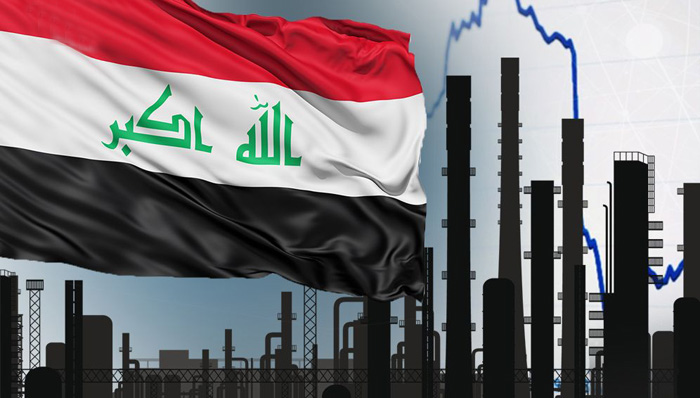
Table Of Content
- Executive Summary
- First: Decline in Crude Oil Exports
- Second: Escalation of Internal Debt and Financing Pressures
- Third: High Unemployment Rates and Pressure from Job Seekers
- Fourth: Complexities of the Economic Relationship with Iran
- Fifth: Resetting the Oil Relationship with China and India
- Sixth: Trade Balance Imbalance and Its Structural Deficits
- Conclusion and Outlook
Executive Summary
The upcoming Iraqi government stands at a highly sensitive economic crossroads, as it faces an accumulation of challenges that can no longer be delayed without making decisive decisions. These challenges revolve around six main axes: the decline in crude oil exports, the escalation of internal debt, high unemployment rates, the complexities of the economic relationship with Iran, resetting oil relations with China and India, as well as the trade balance imbalance and its structural deficits. This paper presents an analytical reading of each of these axes, supported by numbers and indicators, aiming to draw a clear picture of the current situation and the options available to the decision-maker.
First: Decline in Crude Oil Exports
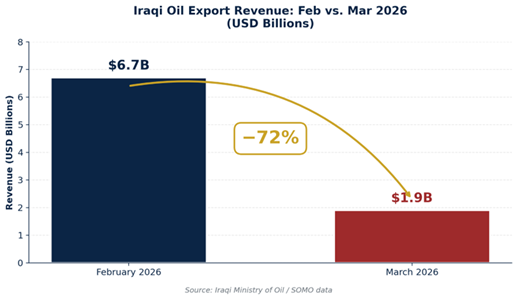
This challenge is the most dangerous of all, considering oil as the main artery of the general budget and the biggest driver of the national economy. For more than two months, Iraqi oil exports have almost completely stopped, currently entering their third month amid the Strait of Hormuz crisis that is hindering the movement of tankers. This has been directly reflected in the numbers; the value of oil exports plummeted from about $6.7 billion in February to only $1.9 billion in March 2026, representing a decline of over 72% in a single month.
Figure (1): Decline in crude oil export revenues between February and March 2026 (Billions of USD)
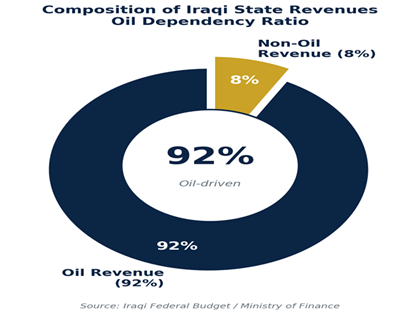
Because oil revenues constitute more than 92% of total state revenues, this decline will negatively and sharply affect public revenues, and its indirect impact will extend to non-oil revenues implicitly linked to oil activity, particularly customs revenues.
Figure (2): Structure of the Iraqi state revenues and the oil dependency ratio
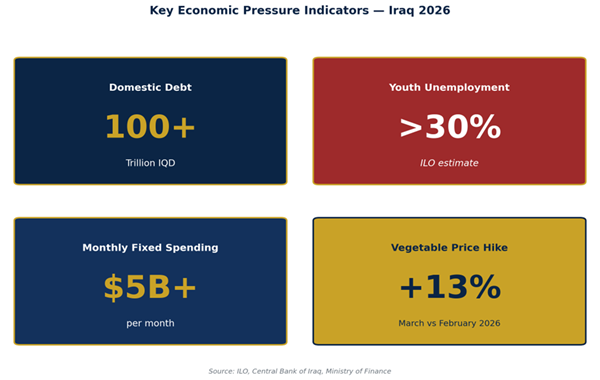
Risk Indicator In the absence of viable export alternatives, it seems the only available option to cover the governing expenditures that exceed $5 billion monthly is internal and external borrowing, until navigation in the Strait of Hormuz stabilizes and the smooth flow of tankers resumes, the timing of which remains unknown.
Second: Escalation of Internal Debt and Financing Pressures
The Iraqi internal debt has surpassed the 100 trillion dinar mark, casting tremendous pressure on local financial institutions that already suffer from weak confidence and a fragile capital base. Consequently, internal borrowing is no longer a viable option, making the search for a foreign financing alternative an urgent necessity.
However, the lack of structural reforms in the general budget and the downgrade of Iraq’s credit rating make it difficult to obtain external loans on favorable terms. Thus, the government’s ability to meet governing operational expenses is at stake, noting that any failure to meet these expenses could translate into social security and civil peace disturbances, leading to complications that will be difficult to contain later.
Third: High Unemployment Rates and Pressure from Job Seekers
Despite the scarcity of accurate official indicators, International Labour Organization (ILO) data indicates that the unemployment rate among Iraqi youth exceeds 30%, and the labor market receives more than 500,000 new entry requests annually. With the decline in GDP due to the contraction of oil exports, which contribute about 65% of its total, and the weak contribution of other productive sectors, unemployment rates are expected to rise significantly.
The government will find itself facing mounting pressure from the youth demographic the largest segment demanding the opening of government appointments, a recipe that previous governments have conventionally used to absorb social unrest. However, the equation today is radically different; with declining revenues and expenditures inflating to unprecedented levels, expanding government employment will be almost impossible, which doubles the political and social pressure on the upcoming government.
Figure (3): Dashboard of key economic indicators pressuring the upcoming government
Fourth: Complexities of the Economic Relationship with Iran
Iran is a pivotal trade partner for Iraq, as the volume of trade exchange between the two countries exceeds $12 billion annually, led by Iranian gas exports at more than $5 billion, as well as various goods, most notably foodstuff. With the tightening of US sanctions on Tehran following the recent crisis, Washington is expected to exert escalating pressure on Baghdad to reduce or freeze this exchange, aiming to cut off the flow of hard currency to the Iranian side.
In the absence of comparable alternatives in terms of price and quality, any disruption of this trade channel will translate into inflationary pressures on goods, especially food.
Field Indicator Vegetable prices rose by 13% in March compared to February 2026 as a result of the interruption of part of the Iranian supplies, which is the first sign of an inflationary impact that could widen in scope.
Fifth: Resetting the Oil Relationship with China and India
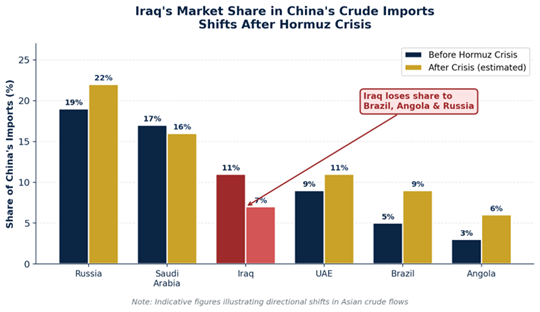
Amidst the Strait of Hormuz crisis and the decline in Gulf oil exports, China and India the largest importers of Iraqi oil rushed to find alternatives, finding their solutions in Brazil and Angola, in addition to increasing the pace of imports from Russia. This was coupled with the United Arab Emirates’ withdrawal from OPEC, which will enhance its export capabilities and allow it to seize additional market shares in Asian markets.
Figure (4): Shift in Iraq’s share in the Chinese oil market after the Hormuz crisis (illustrative percentages)
Replacing these alternative countries’ oils with Iraqi oil once the crisis eases will not be an automatic process, but will require a set of measures:
- Active diplomatic movement to rebuild relations with both Beijing and New Delhi.
- Offering packages of price discounts and contractual concessions to regain lost market shares.
- Temporarily sacrificing some presumed revenues to restore the competitive position.
It is likely that the phase following the end of the crisis will witness the beginning of a price war in the oil market among producers, which requires prior preparation and high negotiation flexibility from the Iraqi side.
Sixth: Trade Balance Imbalance and Its Structural Deficits
Although Iraq still maintains up until March a trade surplus in its overall balance with the world, this surplus is threatened with erosion due to the decline in the value of oil exports. Besides this, the trade balance suffers from deep-rooted structural imbalances at the bilateral level with a number of trading partners.
Figure (5): Iraq’s bilateral trade deficit with major partners (Billions of USD)
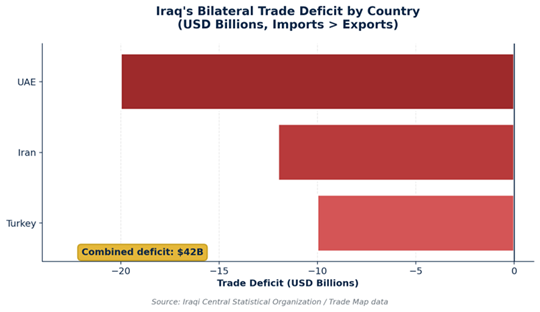
With the decline in oil revenues, this deficit will cast a shadow over Iraq’s ability to finance its imports, necessitating a resort to the Central Bank’s reserves to bridge the gap. Consequently, the challenge becomes twofold: restructuring economic relations with countries with which Iraq suffers a large deficit, while simultaneously maintaining the overall trade balance surplus despite the decline in oil sales.
Conclusion and Outlook
There are additional challenges related to stalled sectors such as agriculture, industry, and tourism, but the six aforementioned challenges remain the most urgent and critical on the upcoming government’s agenda.
What is required today is to move beyond the traditional management approach followed by successive governments, and to proceed towards fateful decisions and deep, surgical reform measures, even if their interim cost is high for the national economy. Continuing the same approach under these exceptional circumstances is no longer a sustainable option.
Final Recommendation The current reality necessitates a comprehensive re-engineering of Iraq’s fiscal, monetary, and trade policies to ensure the diversification of income sources, reduce the fragility of the oil sector, and rebuild trust in local financial institutions, along with drafting an integrated strategy to manage regional and international economic relations in a way that serves the supreme national interest.

Manar Alobaidy
Manar Al-Obaidi: An Iraqi engineer and economic analyst, and the Executive Director of the Future Iraq Foundation for Economic Research. Known for his "engineering precision" in diagnosing the Iraqi economy's structural flaws, Al-Obaidi relies on data-driven analysis rather than traditional political discourse. His work focuses extensively on foreign trade, private sector growth, and non-oil revenue development, making him a trusted reference for simplifying complex financial trends and enhancing public and investment awareness of market dynamics.

For your next post.Thanks
For your next post.Thanks
For your next post.Thanks
Subscribe for your next publication. Thanks