


The International Maritime Transport System and the Hypothesis of Iraq’s Geographical Significance in Linking Freight Movement Between Asia and Europe
An in-depth analysis of the challenges facing Iraq as an alternative trade corridor between Asia and Europe, exploring realistic options to enhance its role in the regional transport system.

Introduction
The twentieth century witnessed numerous and significant shifts in the methods, routes, and patterns of maritime freight transport between the world’s countries and continents. These changes, driven by various factors, fundamentally altered the shape of the international transport industry and helped form a global supply chain system characterized by fluidity, flexibility, and efficiency. This evolution has reflected positively on the economic growth of many nations worldwide.
Table Of Content
- Introduction
- An Overview of the Development of International Commercial Maritime Transport Economics
- The Hub & Spoke System
- Growth in Vessel Size
- The Formation of Transshipment Markets
- Multimodal Transport Systems
- The Feasibility of Iraq as a Connectivity Hub Between East and West
- The Optimal Transport Model for Iraq
- Sources
This article highlights the development of the commercial maritime transport industry and its global system. It also examines the feasibility of shifting international transport routes from Asia toward Europe via Iraq, and the options available for Iraq to become a vital and significant component of this system.
An Overview of the Development of International Commercial Maritime Transport Economics
In the early twentieth century and prior, commercial maritime operations relied on transporting general or break-bulk cargo in open vessels. These operations involved primitive loading and unloading methods that required large numbers of laborers and significant time and effort. These processes caused delays, depleted resources, increased costs, and led to cargo damage, resulting in substantial losses for traders and manufacturers.
A turning point occurred after World War II when American Malcolm McLean, in 1955, innovated the prototype of the modular shipping container. This revolutionary invention transformed local and international transport by facilitating and accelerating loading, transport, and unloading processes while significantly reducing costs and human labor. This encouraged companies and nations to modernize all transport-related sectors, including ship designs, port infrastructure, handling equipment, road networks, locomotives, and trucks, to achieve maximum economic and operational efficiency.
In the mid-1960s, as demand for containerization grew, shipping lines began offering direct services connecting production ports with importing ports via specific corridors. This became known as the “Point-to-Point” transport system. While it initially aided the flow of containers, the system eventually faced challenges due to surging demand. Between 1970 and 1980, container transport demand rose from 717 million tons to 1.225 million tons annually, causing port congestion and supply chain disruptions. To address this, the industry transitioned from direct “Point-to-Point” systems to the “Hub & Spoke” indirect transport model and invested in larger container ships.
The Hub & Spoke System
In this system, maritime transport operations differ from the old model. Ports are divided into local (spoke) ports and hub ports within each region. Local ports are connected to hub ports via small or medium-sized “feeder” vessels that transfer containers through a process called “transshipment”.
Once containers are gathered at a hub port in the exporting country (e.g., Shanghai), massive “mother vessels” load them and head toward another hub port (e.g., Rotterdam) along a “Long Haul” route. Along the way, the mother vessels visit a limited number of regional hubs. This model allows shipping companies to maximize vessel utilization, ensure steady delivery times, and offer competitive, low-cost freight rates.
Growth in Vessel Size
To improve efficiency, international shipping lines adopted a strategy of fleet expansion with larger vessels. As vessel capacity increases, the cost per container per nautical mile decreases—a concept known as “Scale Economies”. Historically, container ship sizes have increased by 1200% from 1968 (1,530 TEU) to 2018 (22,000 TEU). By 2023, ships with a capacity of 24,000 TEU entered operation, with designs for 30,000 TEU vessels already prepared, confirming the economic feasibility of larger vessels in the global market.
The Formation of Transshipment Markets
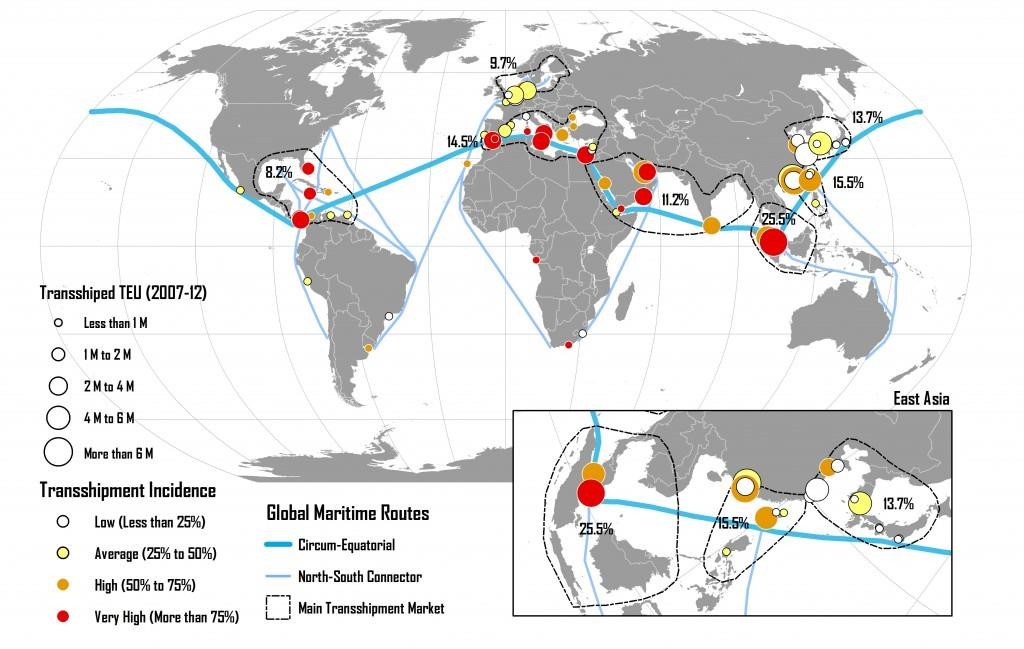
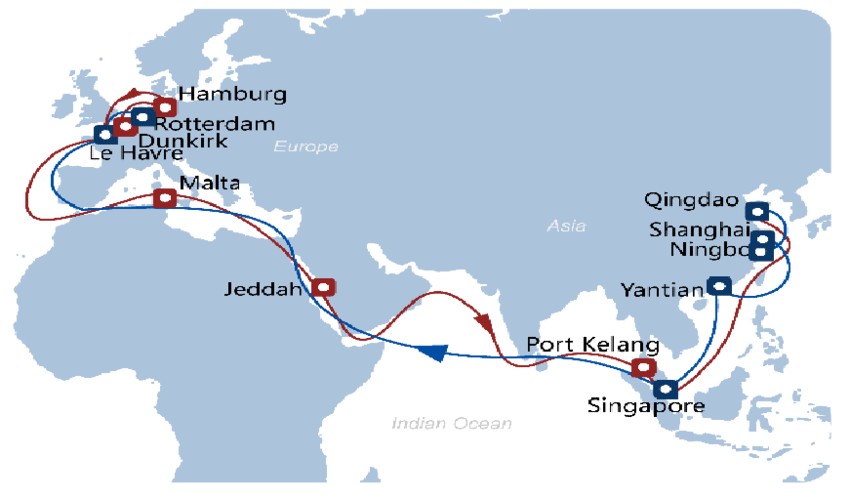
The success of the Hub & Spoke system and mega-vessels led to the formation of regional transshipment markets. These markets connect global and regional supply chains through logistics networks, multi-modal transport, factories, warehouses, and distribution centers. In the Middle East, for instance, local ports in the Arabian Gulf or Red Sea are linked to three or four major transshipment hubs. A typical Asia-Europe route (e.g., CMA-CGM) starts in China, passing through Malaysia, Singapore, Jeddah, the Suez Canal, and Malta, before ending in Western Europe. This journey takes approximately 30–32 days with weekly scheduled trips.
Multimodal Transport Systems
The evolution of maritime transport was accompanied by the development of multimodal transport. Previously, “Point-to-Point” or “Port-to-Port” shipping left the responsibility of inland transport to the cargo owner. Competition led companies to integrate maritime, rail, road, and river transport into a seamless “Door-to-Door” service. This served as one of the first value-added services in the industry, facilitating the global expansion of logistics and supply chains.
The Feasibility of Iraq as a Connectivity Hub Between East and West
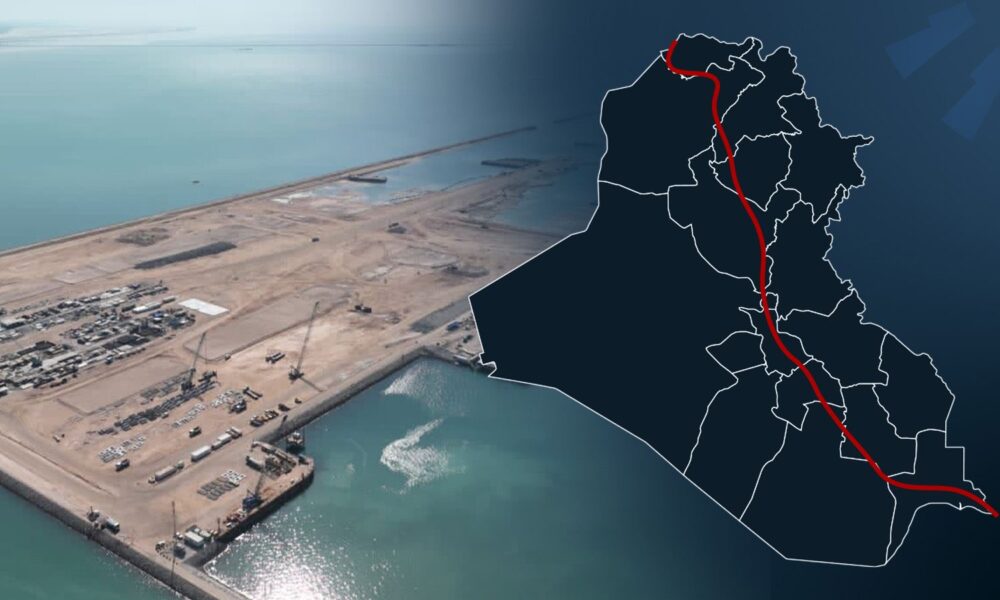
Since 2003, there has been much discussion in Iraq regarding its potential to serve as a transit state for international trade between Asia and Europe. Proponents argue that Iraq’s geographical location qualifies it as a suitable land bridge, potentially offering shorter transit times and lower costs compared to the Suez Canal. They suggest this would encourage international shipping lines to unload at Iraqi ports (specifically the Grand Faw Port) for overland transport to Turkey and then Europe, creating vast revenue and employment opportunities.
Despite the appeal of this vision, significant obstacles hinder its realization:
- Geographical Constraints: Iraq is located at the northern end of the “closed” Arabian Gulf with limited maritime access. This places Iraqi ports far from the primary international Asia-Europe maritime routes. Consequently, Iraqi ports are classified as local feeder ports, usually served via transshipment from hubs like Jebel Ali or Khorfakkan.
- System Stability: Current Asia-Europe routes rely on the Hub & Spoke system and the Suez Canal. Existing supply chains are built around these stable routes, making it economically and operationally impractical to divert them through Iraq.
- Unimodal vs. Multimodal Costs: The Suez Canal route offers a low-cost, unimodal service. Transit through Iraq would require a multimodal shift (sea to rail/road), significantly increasing transport costs and reducing competitiveness.
- Economic Ratios: For efficiency, maritime transport should constitute at least 80% of the total journey. Sea transport is the cheapest mode; when land transport exceeds economic limits, the service becomes uncompetitive. In Iraq’s case, the land portion could reach 45% of the journey, potentially making it 35% more expensive than the direct Suez route.
- Handling Operations: Direct sea transport involves an average of 4 handling operations. Moving through Iraq would increase this to 6–8 or more, raising total costs, transit time, and insurance premiums.
- Volume of Trade: The volume of containers is massive; in 2021, 21.2 million TEUs were transported from China to Europe alone. Only mega-vessels can handle these volumes efficiently.
- Logistical Bottlenecks: Approximately 100,000 containers move daily from Asia to Europe. Handling such volumes daily at a single port for land transit would inevitably cause “bottleneck effects,” disrupting schedules and causing massive losses for shipping lines and traders.
- Operational Costs: Mother vessels have daily operating costs of $130,000 to $180,000. Entering the Gulf to reach Iraq and returning would drastically increase voyage costs, making the freight rate uncompetitive.
- Time Delays: Diverting mother vessels into the Gulf would add at least six days to the voyage, causing delays for other ports and further increasing costs.
- Opportunity Costs: Mother vessels maximize “Scale Economies” by loading and unloading as much as possible at hub ports. Iraq cannot guarantee sufficient export cargo to replace the containers unloaded for land transit, leading to financial losses for the shipping companies.
- Regulatory Burdens: Providing international transit services imposes legal, economic, and security responsibilities on the host state. The resources required to secure and manage these movements may exceed the transit fees collected.
- Private Sector Priorities: Shipping companies are profit-driven and adhere to “Lean” business models. They do not divert routes for political agreements (like the Belt and Road Initiative) unless there is a clear economic benefit.
- Existing Alternatives: China already utilizes land corridors (the Silk Road Economic Belt) for time-sensitive cargo; sea-to-land transit through Iraq would be slower and more expensive than these existing options.
- Reliability and Security: Geopolitical instability or border closures can disrupt land routes, making them less reliable than maritime transport in international waters.
- Customer Choice: Customers prioritize low cost, high reliability, and suitable transit times. Given the options, most would choose direct sea routes over indirect, more expensive land transit through Iraq.
Therefore, Iraq’s current geographical position does not allow it to serve as a substitute for primary international routes. Instead, it must focus on viable alternatives within the regional and international transport industry.
The Optimal Transport Model for Iraq
Establishing a modern port with large capacity, such as the Grand Faw Port, is a strategic necessity for Iraq. It will enhance import/export capabilities and serve as a pillar for development and production projects. This requires a vast network of modern land infrastructure, including roads, bridges, tunnels, and commercial rail networks.
Such a system would allow Iraq to become a regional economic player. It could foster regional partnerships, creating a multimodal network where Iraq serves as a central link for intra-regional trade. Over time, this would become a source of economic and political strength.
Additionally, the Grand Faw Port and associated land networks could attract a portion of time-sensitive cargo from the Indian subcontinent and the Gulf toward Europe. For time-sensitive goods (agricultural products, pharmaceuticals, specialized equipment, etc.), delivery speed is more critical than cost. Iraq’s land corridors could offer the shortest and fastest route for such shipments, provided there is a stable political and security environment and sustained safety.
Sources:
2. https://unctad.org/system/files/official-document/dtl2018d1_en.pdf
4. https://www.isesassociation.com/50-years-of-container-ship-growth/
6. https://www.researchgate.net/figure/Specific-route-of-China-to-Northern-Europe_fig3_338157929 7. https://www.porteconomics.eu/transshipment-hubs-connecting-global-and-regional-maritime-shipping-networks/
All rights reserved to the Iraqi Economists Network. Republication is permitted with attribution to the source. May 8, 2023.

Ziad Al-Hashimi
Ziad Al-Hashimi is an Iraqi economic expert and consultant specializing in the commercial transport sector, supply chains, and global trade. His primary focus is on studying and analyzing the international maritime transport system, the evolution of global shipping routes, and the movement of goods between Asia and Europe.
No Comment! Be the first one.