



Iraq’s Development Road: From a Path Paved with Challenges to an Integrated Sustainable Economic Model
Over the past years, Iraq has sought to enhance the diversification of its economy, reduce its heavy reliance on oil revenues, and gradually phase out the state of a highly rentier economy by...

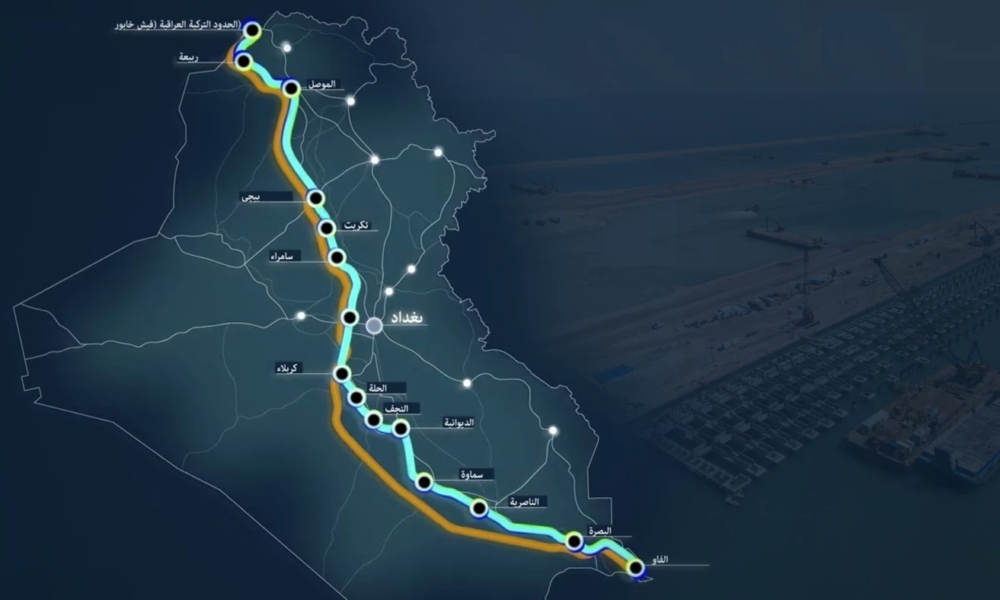
Prominent among these initiatives is the “Development Road” project, announced by the Iraqi government in May 2023, which the Iraqi government classifies as a promising strategic project that will be a qualitative addition to the regional and international transport sector. Initially, the “Development Road” project caught the attention of some countries and companies due to the promising economic opportunities it might hold for both international investors and even Iraq, a country that has long suffered from isolation and internal and regional conflicts. According to the official Iraqi vision, this project aims to transform Iraq into a central hub connecting East and West trade using a multi-modal transport network linking maritime transport at Iraqi ports with railways and highways within and beyond the Iraqi geography.
Table Of Content
According to the plans revealed by the Iraqi government, the “Development Road” consists of two land corridors: one dedicated to truck transport and the other a railway line for freight trains. This road starts from the Al-Faw port in the far south of Iraq, passing through ten Iraqi governorates, all the way to the Turkish border, covering an estimated distance of about 1,200 kilometers. At the Turkish border, the road will connect to the Turkish transport network, providing direct access to Europe. According to some reports, official authorities in Iraq believe that the routes of this project can theoretically reduce the commercial transport journey time between Asia and Europe to 15 days, while cutting transport costs by up to 30%. It is also expected that industrial cities will be established along the “Development Road” route during later stages, which will contribute to supplying the Iraqi market with diverse products, supporting the national economy with financial resources, and providing job opportunities for tens of thousands of Iraqi youth.
The Iraqi government has made significant efforts on the regional and international levels to promote the “Development Road” project, aiming to attract countries and companies into investment partnerships that contribute to funding and launching this ambitious commercial transport project, with its first phase estimated to cost around $17 billion. These efforts have resulted in the signing of memorandums of understanding with Turkey, Qatar, and the United Arab Emirates, indicating a shared desire to enhance cooperation among these countries in the commercial transport sector, as well as to explore investment opportunities in the project.
These countries believe that the Development Road routes will provide a major opportunity to raise the level of trade exchange between Turkey and its neighbors on one side, and the Arab Gulf states on the other, considering that this route represents a shortcut between the parties that helps achieve fast access for goods and commodities at reasonable transport costs.
Although the Development Road route could indeed be feasible for these countries in their mutual trade exchange operations, the volume of trade exchange between the Gulf states, Turkey, and even Eastern European countries will not be sufficient alone to cover the high operational costs of the Development Road’s railway route. This requires massive and continuous flows of containers in both directions to achieve a high operational level that covers total costs and achieves a suitable profit margin. This may explain the hesitation of many parties to enter into investment partnerships with Iraq to fund the phases of the Development Road project, due to doubts about its economic and commercial competitiveness and feasibility, and because of question marks surrounding the Iraqi government’s method of managing the Development Road project file. This includes commissioning an obscure Italian company, which is not specialized in the international transport sector, to study the feasibility of this strategic and vital project, prompting many countries and parties to pause before investing in and funding this project, waiting for the Iraqi government’s decision on how it will deal with the challenges facing the project.
These challenges can be placed under three main headings: geographical location, the controls and constraints of the international transport system, and the geopolitical cost.
1. Geographical Location of Iraq
Theoretically, and based on the shape of maps, Iraq can be considered to have a geographical advantage that helps it shorten commercial transport distances between Asia and Europe, based on the fact that Iraq enjoys a central strategic location situated between continents. This could make it a pivotal focal point for connecting Asian trade heading to Europe and vice versa, similar to ancient trade and transport routes. However, conversely, we find that Iraq is situated in a geographic location that places it in the north of a semi-closed gulf, with a narrow maritime outlet to international waters, and far from the main maritime routes of the modern international transport system, which leads to its ports being classified as secondary inland ports.
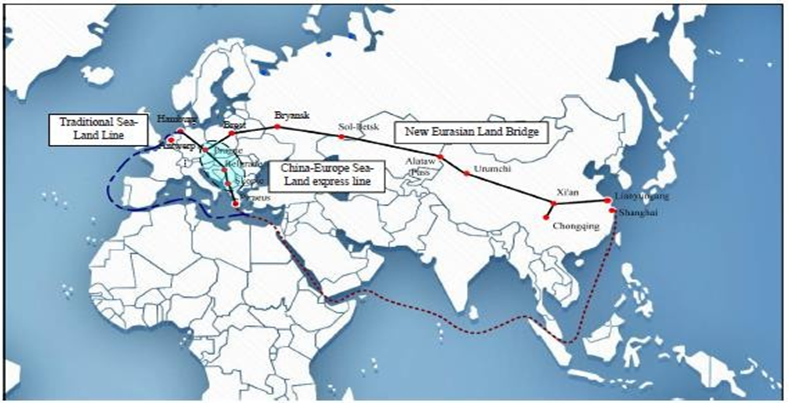
This location, with its limited and semi-isolated maritime frontage, greatly restricts the ability of giant vessels which navigate the main maritime routes between Asia and Europe via the Suez Canal from reaching the ports in Iraq. Instead, they settle for serving ports in the lower Arabian Gulf that have strategic locations close to international maritime routes (such as the Jebel Ali and Khor Fakkan ports in the United Arab Emirates). This makes them hub ports where mother ships head to unload and load containers, and upon which Iraqi and other secondary ports inside the Gulf rely to receive their quotas of containers arriving from Asia or Europe. On the land level, Iraq is also located far from the railway routes that launch from Chinese industrial cities across Central Asia towards consumer centers in Europe, which are known as the Eurasian Land Bridge.
These routes are used by China to transport high-value products that require fast access to European markets, meaning any deviation from this route or the maritime route and diverting them towards Iraq would cause a significant delay in the journey and higher transport costs. Therefore, the geographic factor is one of the hardest challenges Iraq will face regarding promoting the Development Road and its importance for the transport route between Asia and Europe.
Figure (1) – Main maritime transport routes and Chinese railway routes to Europe, noting Iraq’s geographical distance from both routes.
2. Controls and Constraints of the International Transport System
On the other hand, and assuming the possibility of mother ships entering the Gulf and reaching Iraqi ports, the proposed Development Road routes linking Asia and Europe offer nothing more than multimodal transport that mixes maritime and land transport. In this mode, costs and the chances of encountering obstacles rise with the increasing length of the land journey, the transfer process from one mode of transport to another, and the elevated costs for customers when using these routes towards Europe, compared to direct maritime transport. Direct maritime transport via a single mode is considered the cheapest globally and offers massive loading capacities, unlike railway transport which has limited loading capacities. Large ships can accommodate between 18,000 to 24,000 containers.
Therefore, maritime transport is considered the backbone of international trade and global supply chains, capturing over 85% of the global trade volume at lower costs ranging between 30% and 60% compared to all types of land transport.
Because of the lengthy land route crossing multiple countries’ borders, it is expected that insurance companies will impose high fees on every container passing through Iraq, or they might completely refuse to cover containers with any insurance policy during their land journey inside Iraq. This will complicate or prevent the routing of shipments from Asia via the Iraqi land route towards Europe.
Regarding smoothness, the transition from maritime transport to land transport usually creates what is known as a “bottleneck effect”. The movement of containers stalls due to expected ship congestion at the Al-Faw port and long waiting periods as a result of the massive volume of containers requiring unloading and loading, coupled with the limited capacity of the ports. This is in addition to other causes of delay, starting from handling operations, the pile-up of containers at the port docks, reloading them once again onto trains or trucks, and the passage of those containers through border points on a long land journey towards Europe requiring covering a distance of up to 5,000 kilometers or more. They may be subjected to delays, stoppages, and extra waiting due to inspection operations, unrest, or technical issues in the countries through which the Development Road routes pass, among other obstacles. All of this will raise costs and increase goods delivery times. Conversely, the exact same containers can be transported via direct maritime transport with high smoothness, as ships sail from Asian ports across open international waters and oceans directly towards European ports, without facing the obstacles and hurdles encountered by land transport through Iraq.
The smoothness of maritime transport and the high reliability of ship routes have allowed maritime shipping companies to set precise schedules for ship voyages across the world’s ports. This has opened the door for supply chains, factories, logistics companies, and end-receivers to precisely plan and design their operations relating to manufacturing, value addition, storage, and processing, achieving a high level of efficiency and quality (also relying on land transport for short and medium-distance hauls to provide door-to-door services). Furthermore, maritime transport provides an efficient operational capability to manage the turnaround movement of containers between continents and plan the route for outbound full containers and their return route empty—a process that is very difficult to manage and distribute cost-wise via land transport. This means that adding the Development Road routes to the overall route between Asia and Europe will cause a disruption in the container management process, leading to a massive accumulation of containers in some areas and severe shortages in others, representing a major setback in the operation of the international transport system.
Among other important issues worth noting is that the transport companies’ choice of maritime transport routes and modes, and investing in them, did not come as a mere conjecture from their management, but rather relied on the preferences of customers and companies in consumer centers in Europe. Field surveys have shown that the European customer prefers, for transporting their goods from Asia, the transport mode with high reliability, followed by the cheapest price, and then the one providing ready loading capacities. All these preferences tilt in favor of international maritime transport. Consequently, offering a long land transport service via the Development Road, preceded by an equally long sea voyage, will not be able to attract sufficient market shares because the transport services via the Development Road do not align with the requirements and preferences of European customers, which is a major obstacle for the Development Road routes.
Factors that matter to the European customer in choosing the transport route and mode from Asia to Europe
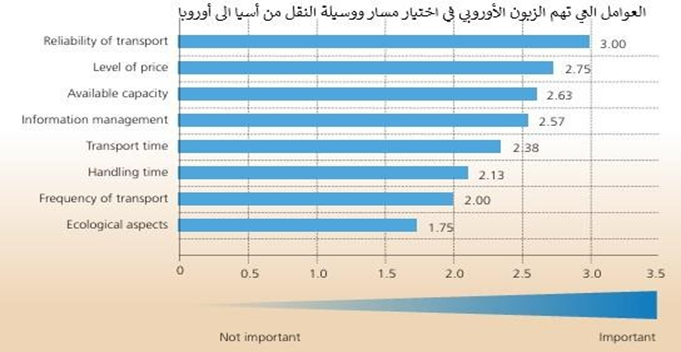
Chart Representation: Preferences of European customers regarding the choice of transport mode or route from Asia. Measurement scale ranges from 0.5 to 3.5 , categorized from “Not important” to “Important”.
3. Geopolitical Cost
From a security and geopolitical perspective, the Development Road, which stretches across long land routes passing through multiple countries to reach Europe, carries significant geopolitical costs that Iraq must bear. These include the cost of taking responsibility for protecting international goods passing through Iraqi land up to crossing its border points, and ensuring the safety of the Development Road lines and routes, whether railways or highways. Additionally, to guarantee the continuous flow of goods through the land routes of other countries arriving in Europe, Iraq must maintain the best diplomatic and economic relations with transit countries. It must show high flexibility to ensure the continued stability of relations with those countries and work to avoid any influences that might strain these relations and negatively affect the continuity and smoothness of trade movement via the Development Road route.
This geopolitical cost will always be demanded from Iraq as a condition for the continuous flow of containers and goods on the Development Road routes to and from Europe.
It is unknown how much this compounded cost will drain from Iraq’s resources, whether political, financial, economic, or even security-related, especially since there are no guarantees confirming Iraq’s ability to continue bearing these burdens for long periods. Naturally, the customers of the Development Road routes will also bear a significant part of this cost, which will raise the prices of transport services via the Development Road and reduce its competitiveness and attractiveness in the international transport market.
It is worth noting here the Chinese experience in this area, where China bore significant geopolitical costs to establish, operate, and manage its land corridors connecting it to Europe via railways. These costs were not limited to the financial aspect alone, which averaged between $17 and $21 million per single kilometer, but also included maintaining diplomatic and economic relations with transit countries such as Central Asian nations, the Caucasus, Iran, Turkey, and Russia. Furthermore, China was sometimes forced to help fund developmental projects and infrastructure development in some transit countries (within its famous Belt and Road Initiative). Therefore, China’s railway routes to Europe can be considered among the most geopolitically expensive transport routes.
4. The Optimal Model for the Development Road
To deal with these challenges and put this project on the right track, it is essential to start by reconsidering the project model, restudying its economic and commercial feasibility, and formulating an integrated model that mixes transport and development and interacts with the dynamics of international markets and trade. The main focus should be on the industrial cities, logistics, and service centers linked to the Al-Faw Port and the development routes. Plans must be laid out to encourage investments in these cities and establish partnerships with international supply chains to attract all or part of their operations and localize them in those industrial and logistics cities, launching manufacturing operations, value addition, and exporting or re-exporting to foreign markets starting from Iraqi geography.
This step will create a major importance and need for the land routes and the port to connect Iraqi manufacturing and logistics centers with supply and manufacturing chains between Asia, Europe, and the Americas. This will encourage investors to enter to fund the construction of the road routes, which will then be clearly linked to the aforementioned manufacturing and logistics centers, potentially becoming a revenue- and profit-generating project in its own right. This is especially true with the launch of the wheel of national production and the start of exports for products manufactured or serviced locally in those centers, ready to use the development routes for export towards global and particularly European markets. It takes advantage of the geographic proximity to Europe and the shortness of the Iraqi supply chain to penetrate those markets and compete with other origins to secure larger market shares.
What helps Iraq attract Asian (and particularly Chinese) supply chains and manufacturing centers is the migration of some of these industries and supply chains westward, moving closer to Western consumer centers. The reasons for this include shortening long supply chains which previously faltered due to long distances, especially during the pandemic period. Another reason is the American and European pressures on Chinese products and the imposition of high customs duties on them, causing their prices to rise and their competitiveness to weaken. Several countries have benefited from the migration of supply chains and have managed to attract some of them, such as the UAE, Saudi Arabia, Egypt, Tunisia, and Turkey. Therefore, Iraq has an extremely large opportunity to attract other Chinese industries and supply chains, integrate them into the updated Development Road model, and localize them in manufacturing and logistics centers linked to the port and the road. These chains include electronic and electrical products, building materials, industries, electric car parts, manufacturing and metal industries, and even textile and clothing supply chains.
Although there is a reference to economic cities in the current Development Road model, there is a clear shortcoming in highlighting them and giving them priority in marketing, investment, construction, and completion in parallel with the construction and completion of the land routes. Logistics and manufacturing centers in the current model are referred to secondarily, which is considered a major flaw in this model, as these centers serve as the primary building block and the key to the success of transport routes, without which there will be no chance for these projects to succeed.
This strategic integration within a single economic model that blends commercial transport, manufacturing, supply chains, and logistics inside Iraqi geography will work to achieve optimal operation of the Development Road routes. It will utilize available transport capacities characterized by high reliability and smooth transport flow, in addition to their price competitiveness due to their proximity to Western consumer centers on one hand, and the shortening of the route between regional countries on the other. This enhances the chances of increasing Iraq’s market shares externally and creates diverse financial revenues generated primarily through Iraqi exports, then through mutual commercial transit fees between regional countries, and revenues from transporting Iraqi products and distributing them among Iraqi cities for domestic consumption. This will open the door to creating promising investment opportunities that attract more investments and businesses, gradually transforming Iraq into a pivotal regional player in the transport, services, supply chains, and diverse industries sectors. It will allow the country to achieve sustainable and even growing financial surpluses, and elevate Iraq’s value and its geo-economic and even geopolitical influence regionally and internationally.
5. Conclusion
From the above, it can be said that despite the clash and intersection of political ambitions with economic constraints in the Development Road project, the opportunity is still favorable for Iraq to develop the project’s current model to be a sustainable developmental model where transport integrates with industry and services. This will supply the Iraqi economy with the modern development sectors and industries it needs, attract investment partnerships, draw national human capital, and gradually contribute to achieving the targeted economic diversification by reducing the high dependency on oil revenues. At the same time, it will achieve the most important goal of the Development Road: that the very first train or truck moving on the road’s routes must be loaded with the first shipment of goods stamped “Made in Iraq”.

Ziad Al-Hashimi
Ziad Al-Hashimi is an Iraqi economic expert and consultant specializing in the commercial transport sector, supply chains, and global trade. His primary focus is on studying and analyzing the international maritime transport system, the evolution of global shipping routes, and the movement of goods between Asia and Europe.
No Comment! Be the first one.